
Tk 63.80 Crore Collected in Toll Revenue During 10-Day Eid Period in Padma and Jamuna Bridge
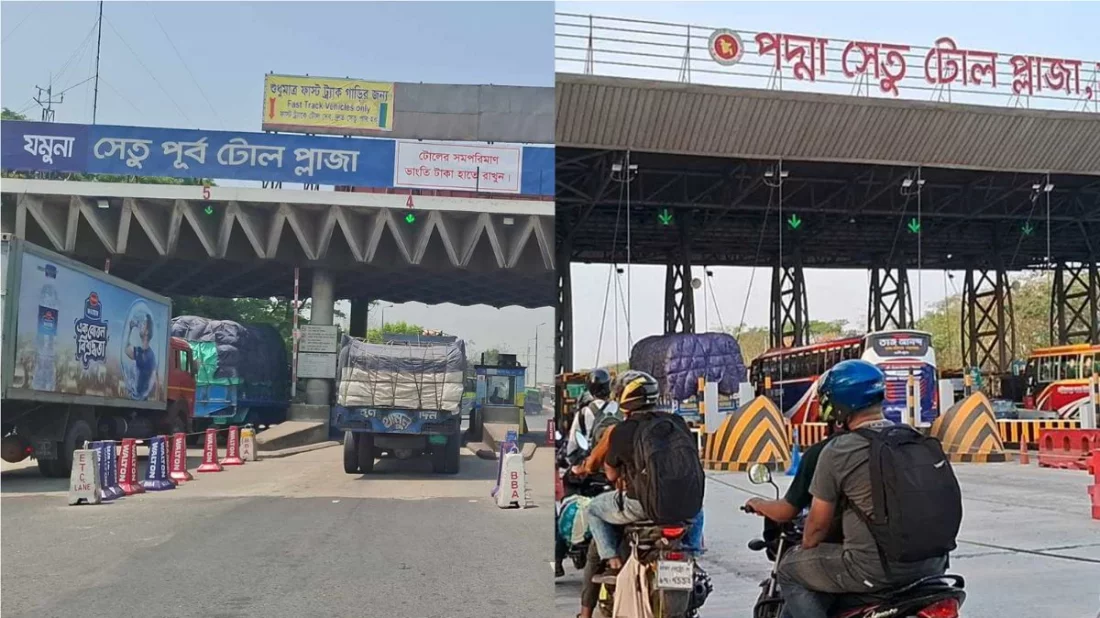
Padma and Jamuna bridge collectively have earned Tk 63.80 crore tolls within just ten days around Eid-ul-Azha has once again demonstrated that Bangladesh’s major infrastructure investments are not only transforming transportation networks but also generating long-term economic benefits for the country. In particular, the latest figures have revived debate over the skepticism and criticism that once surrounded the Padma Bridge project.
According to data from the Bangladesh Bridge Authority, a total of 318,515 vehicles crossed the Padma Bridge between May 21 and May 30, generating more than Tk 361 million in toll revenue. During the same period, the Jamuna Bridge recorded 361,482 vehicle crossings and collected nearly Tk 277 million in tolls. The fact that the Padma Bridge accounted for the larger share of total toll revenue reflects its growing importance to the economic activities of Bangladesh’s southwestern region.
During the planning and construction phases of the Padma Bridge, many critics and economists questioned the project's cost, economic viability, and potential profitability. Their argument was that there was considerable uncertainty about whether a bridge built at such enormous expense would generate the expected economic returns. Some even described it as a misguided development priority.
However, reality is now presenting a different picture. Since the bridge opened to traffic, transportation costs in the southern region have declined, travel times have been significantly reduced, and new opportunities for industrial development and investment have emerged. Even during periods of heavy travel demand, such as the Eid holidays, the bridge has played a crucial role in sustaining the country's economic momentum. The toll revenue generated in just ten days illustrates the rapid growth in its usage.
Of course, the success of a mega-project cannot be measured solely by toll income. Its true value lies in its broader impact on regional development, employment generation, trade expansion, and increased investment. The Padma Bridge has enabled agricultural products from the southwestern districts to reach Dhaka and other major markets more quickly and efficiently. Positive changes are also becoming visible in tourism, industry, and the service sector.
The smooth movement of nearly 680,000 vehicles during the Eid period and the collection of hundreds of millions of taka in revenue within a matter of days represent more than just impressive statistics. They symbolize the country's growing capability and confidence. A project that was once labeled by some as “economically unjustified” or a “wrong decision” is now delivering tangible benefits to ordinary citizens and the national economy alike.
Therefore, the latest toll revenue figures from the Padma Bridge are not merely a financial success story. They also serve as a response to the pessimistic forecasts that underestimated the potential of one of Bangladesh’s largest infrastructure projects. Time has shown that the Padma Bridge stands as a transformative investment in the nation’s economic history.
Editor & Publisher: Dr. Amanur Aman, M. Phil (IUK), PhD (NBU-Darjeeling)
Advisor Editor: Ajoy Maitra
Managing Editor: Shanaz Aman, Executive Editor; Mythos Aman
News & Commercial Offices: T&T Road, Thana Traffic More, Kushtia-7000.
Mobile: 01713914570, E-mail: editor@thekushtiatimes.com
All rights reserved © 2022 thekushtiatimes.com