



The national celebration of the 165th birth anniversary of Rabindranath Tagore has once again highlighted an enduring truth of Bengali identity— the practice and study of Rabindranath must reach wider audiences and penetrate deeper into people’s hearts. The speakers at the event observed that if Rabindra practice is stifled, Bengali emotion and consciousness could collapse.
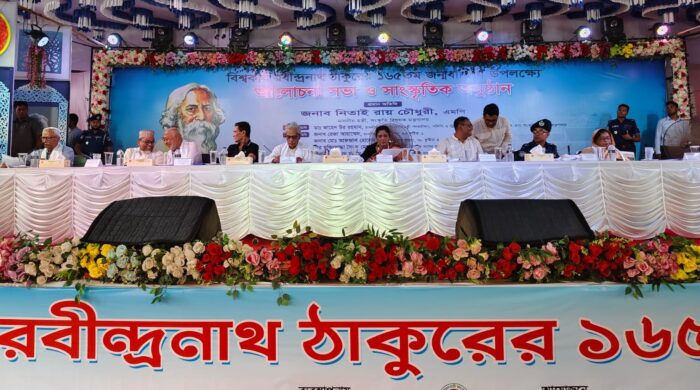
The remarks were made today, on the 25th of Boishakh, at the inaugural event held at the historic Kuthibari of Kushtia’s Shilaidaha. The house is memorable across the world and was once the family residence and estate management place of the poet.
The serene, green and history-enriched riverside village on the banks of the Padma has come alive in remembrance of the Poet Laureate.
A three-day programme has been arranged there to mark the 165th birth anniversary celebration. The event was inaugurated by Minister of Cultural Affairs Nitay Roy Choudhury.
The programme has been organized by the Ministry of Cultural Affairs with the help of Kushtia district administration.
The three-day celebration includes discussion sessions, cultural performances, Rabindra Sangeet renditions, dance dramas, recitations, art exhibitions and various presentations of folk culture. Alongside renowned Rabindra Sangeet artists, reciters, researchers and cultural personalities from across the country, local artists and nearly a hundred cultural organizations are also participating.
The Kuthibari and surrounding areas have already been adorned with colourful decorations. A festive atmosphere now prevails across Kushtia, while Rabindra enthusiasts, cultural activists and visitors from different parts of the country have gathered at the historic site. Temporary stages, seating arrangements, and security barricades have been constructed for visitors. Alongside law enforcement agencies, various government departments are working in coordination to ensure the smooth execution of the programme.
Among those present as special guests were Member of Parliament for Kushtia-1 Reza Ahmed, Member of Parliament for Kushtia-4 Afzal Hossain, Administrator of Kushtia Zilla parishad Sohrab Uddin and Kushtia Superintendent of Police Mohammad Jasim Uddin.
The commemorative speaker on the opening day was Professor Dr. Wakil Ahmed. The session was chaired by Kaniz Mowla, Secretary of the Ministry of Cultural Affairs. Welcome remarks were delivered by Kushtia Deputy Commissioner Touhid Bin Hasan.
In his speech, Cultural Affairs Minister Nitay Roy said that Shilaidaha is not simply a place; it is a living memory of Bengali literature and culture.
“It was here that the Poet Laureate composed countless poems, songs, stories, and letters. The waves of the Padma, the natural beauty of Bengal, the lives of farmers and the joys and sorrows of ordinary people gave his creations a unique human depth,” the minister mentioned.
He further said that therefore, celebrating Rabindra Jayanti in Shilaidaha is not just a formal observance; it is a cultural journey back to the soul of the Bengali people.
Commemorative Speaker/
Rabindranath Tagore is so deeply interwoven with the linguistic, emotions and cultural essence of the Bengali people. Bengali identity itself feels incomplete without his presence. From life’s beginnings to its final moments, his songs and writings continue to shape Bengali experiences and emotions. In joy and sorrow, in love and separation, in struggle and aspiration — he seems to have given language to every human emotion. Therefore, the decline of Rabindra practice would mean the shrinking of the Bengali emotional world.
Today’s world is changing rapidly. Technological advancement, the spread of consumerist culture and increasing social isolation are gradually making human emotions mechanical. In this reality, the literature, music, and philosophy of Rabindranath Tagore act as a powerful remedy that awakens the human spirit within people. His songs teach love, his poetry reconnects people with nature, and his philosophy inspires the courage of free thought. He was not merely a poet; he was one of the foremost architects of the Bengali mind and consciousness.