



On the road to Bangladesh’s great independence, several historical key events became living milestones and the Mujibnagar Government stood as one of the most crucial among them. It was more than a historical episode; rather, it was the real manifestation of strategic political and effective state planning that emerged during a deep crisis of nation’s birth. An objective reading of history shows that in a situation marked by uncertainty in the overall liberation war, absence of leadership and scattered resistance, this government for the first time transformed the liberation struggle into an organized, state-like framework.
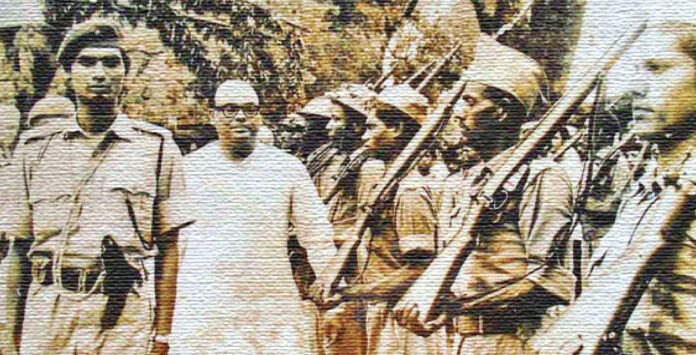
The Operation Searchlight launched by the Pakistani military on the night of 25 March 1971 in Dhaka and other cities directly targeted political leadership and Bangabandhu Sheikh Mujibur Rahman’s declaration of independence, just before his arrest gave moral and political impetus to the Bangali resistance. But, in reality, Mujib’s arrest created a situation of leadership vacuum and scattered resistance across the country. Although independence was later declared by the then Major of Army Ziaur Rahman on behalf of Sheikh Mujib and another political leader, the absence of coordinated leadership continued. To fill this critical gap, the Provisional Government of the People’s Republic of Bangladesh—known as the Mujibnagar Government—was formed on 10 April 1971 became a crucial and strategically necessary step. Latter, the official journey of this government began with the oath-taking ceremony on 17 April at Baidyanathtala in Meherpur (now Mujibnagar).
In its structure, Sheikh Mujibur Rahman was declared President, although he was then imprisoned in Pakistan. Syed Nazrul Islam served as Acting President, and Tajuddin Ahmad became Prime Minister. Other leaders such as Khondaker Mostaq Ahmad, Captain Monsur Ali, and A.H.M. Qamaruzzaman were included in the cabinet. On the military side, Colonel M.A.G. Osmani was appointed Commander-in-Chief of the Liberation Forces.
A key point to note here important that political and military leadership were brought under one unified structure, which created a coordinated command system for war management. As a result, scattered resistance was transformed into a structured and objective-oriented liberation war. This was one of the most significant contributions of the Mujibnagar Government. Because, in the early months of March and April, resistance that started across the country was scattered, uncoordinated and often inconsistent. Different parts of the resistance forces—regular troops, guerrilla units, and local fighters—were not always well coordinated. The provisional government organized these forces into a sector-based system, arranged training, ensured weapons supply and developed operational plans, building both guerrilla and regular forces. Training camps in India, logistical support along border areas and strategic war planning were all made possible through this government. As a result, the war gained continuity and strategic direction.
The government also made important contribution to information dissemination and public opinion building. Through the Swadhin Bangla Betar Kendra (Free Bengal Radio), it spread updates on the liberation war, highlighted atrocities and boosted the morale of the freedom fighters. In liberated zones, it introduced administrative functions, relief activities and a limited form of civil governance. This proved that it was not just a resistance organization but the early form of a functioning state system.
From an international perspective, the diplomatic role of the Mujibnagar Government was highly significant. While Pakistan tried to present the war as an “internal issue,” the provisional government worked to establish it as a national liberation war. Cooperation with India ensured military and humanitarian support, and diplomatic missions were sent to various countries to gain international backing.
Despite the constraints of Cold War politics and shifting global power dynamics, the diplomatic initiatives played a key role in shaping international public opinion and eventually paved the way for India’s direct military intervention.
The deeper analysis also shows that the challenges faced by the Mujibnagar Government were not only administrative or military. First, there was a severe lack of financial resources. Second, the administrative system had largely collapsed, leaving the government with almost no functioning bureaucracy. Third, the absence of Sheikh Mujibur Rahman created not only a leadership gap but also a psychological and symbolic void.
Besides, internally, there were also differences of opinion within the cabinet regarding war strategy, international diplomacy and the future state structure. However, under the strong and practical leadership of Tajuddin Ahmad, these disagreements were managed and did not turn into major divisions.
It is true that the Mujibnagar Government was not a perfect system; rather, it was an effective political-military structure created under severe constraints. Its successes are clear, as are its limitations, both of which are part of its historical reality. However, despite these challenges, it managed to turn the liberation war into a coordinated, purposeful, and internationally recognized struggle.
It can thus be concluded that the Mujibnagar Government was not simply relevant but fundamentally indispensable in both structure and strategy within Bangladesh’s liberation struggle. It unified the resistance, directed the war and established Bangladesh’s political identity in the international arena. Without such a government, the liberation war might have been more prolonged, disjointed and less effective. In historical perspective, it was not just a temporary administration; it was the first practical manifestation of Bangladesh’s statehood, legitimacy and organized political vision.