


On this day, 54 years ago, in 1971, the name of Bangladesh was added to the world map as an independent and sovereign nation. On that historic day of ’71, the sun of freedom rose in the sky among the Bengal green. A red-and-green flag was hoisted with pride. Millions of voices sang out, “Amar Sonar Bangla, Ami Tomay Bhalobashi…”
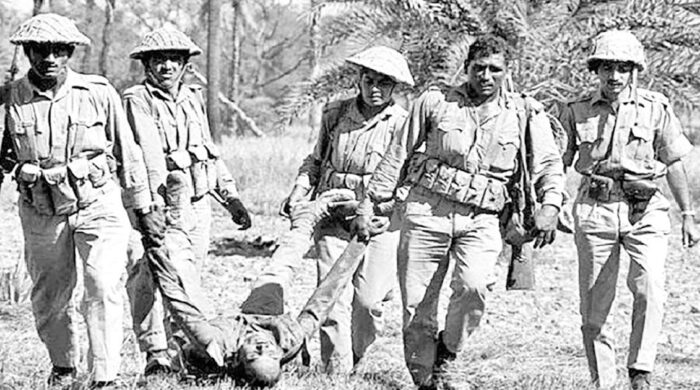
The Great Liberation War of Bangladesh is the greatest and most glorious achievement in the thousand-year history of the Bengali nation. Through this achievement of the Liberation War, Bangladesh today stands firmly established on the world map as an independent and sovereign state. This independence was not a gift; it was earned through a long and bloody struggle. The supreme sacrifice of three million martyrs and the violation of the honor of nearly two hundred thousand mothers and sisters paved the way for our independence through a nine-month-long armed liberation war. A grand example of the deep interwining of patriotism, self-sacrifice, and indomitable resistance refeclts upon this achievement of freedom.
Background of the Liberation War
After the partition of the subcontinent in 1947, based on the two-nation theory, East Bengal became a part of Pakistan under the name “East Pakistan.” The nation was divided into two parts—East Pakistan and West Pakistan—where West Pakistan became the ruler and East Pakistan was reduced to the oppressed. Soon, the ruling elite of West Pakistan turned this land into a colony of exploitation through political, economic, and cultural discrimination. The first attack was on language. Urdu was declared the sole state language, sparking widespread protests. During the Language Movement of 1952, brave students like Barkat, Salam, Rafiq, Jabbar, and Shafiq sacrificed their lives. Inspired by the innocent blood of the martyrs, successive movements followed—the Education Movement of 1962, the Six-Point Movement of 1966, and the Mass Uprising of 1969. In the 1970 general election, the Awami League, led by Bangabandhu Sheikh Mujibur Rahman, achieved a landslide victory. However, the ruling authorities refused to transfer power, resulting in a nationwide mass movement.
Declaration of Independence and the Beginning of War
As the crisis regarding the transfer of power reached its peak, Bangabandhu delivered his historic speech on March 7, 1971, at the Racecourse Ground (now Sohrawardy Udyan) in Dhaka. He demanded the withdrawal of martial law, the return of troops, and the transfer of power, and declared, “The struggle this time, is a struggle for our liberty. The struggle this time, is a struggle for our independence.”. This speech united the nation for the Liberation War and provided a clear direction for independence. UNESCO has recognized it as part of the World Documentary Heritage.
After the March 7 speech, the Bengali people’s sheer desire for freedom became indomitable. When the Yahya–Mujib talks failed on March 24, the Pakistani army launched a brutal genocide on the unarmed Bengali population under “Operation Searchlight” on the night of March 25. Sheikh Mujibur Rahman was arrested that night. Just before his arrest, in the early hours of March 26, he declared the independence of Bangladesh. This declaration was broadcast via wireless, and Awami League leader M. A. Hannan announced it from Chittagong Radio on the afternoon of March 26. The following evening, on March 27, then Major Ziaur Rahman announced the declaration of independence on behalf of Bangabandhu from the Swadhin Bangla Betar Kendra at Kalurghat. This announcement spread across the country, inspired the fighters, and formally marked the beginning of the Liberation War.
Formation of Government and Foreign Support
An interim government was formed on April 10 and took oath on April 17 at Mujibnagar. The country was divided into 11 sectors to organize resistance. Faced with genocide and atrocities by the Pakistani army, nearly ten million people took refuge in India. India, the Soviet Union, and several other countries extended diplomatic and humanitarian support.
Surrender of the Pakistani Army and Final Victory
By December 14, when the joint forces reached the outskirts of Dhaka, the defeat of the Pakistani army became inevitable. Finally, on December 16, Lieutenant General A. A. K. Niazi surrendered unconditionally along with 93,000 troops to the joint command at Suhrawardy Udyan. Thus ended the nine-month-long bloody Liberation War, and independent, sovereign Bangladesh was established on the world map.
Conclusion
By hoisting the red-and-green flag, we have gained a free land—not merely a geographical territory, but an invaluable legacy of dreams, courage, unity, and humanity. It is the sacred duty of today’s generation to keep this spirit alive, honor the sacrifices of the martyrs, and build a more prosperous and just nation. This victory teaches us that when united, no oppressive force is invincible.
Tribute
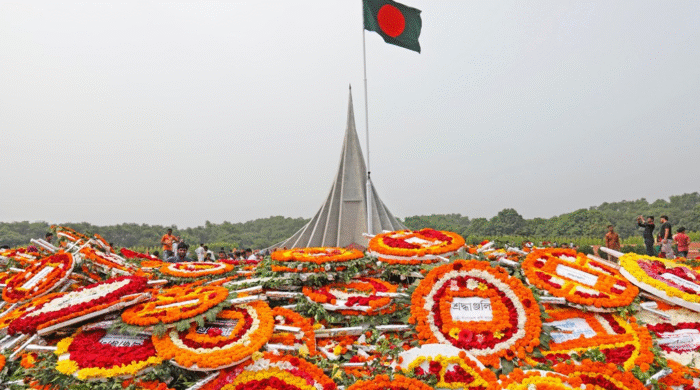
Today, the nation will remember with deep respect and gratitude the brave sons who laid down their lives for independence. The altar of the National Martyrs’ Memorial in Savar will be filled with countless floral tributes.
On the occasion, President Md. Shahabuddin and Chief Adviser Professor Muhammad Yunus issued separate messages.
President Shahabuddin stated that to deliver the true benefits of independence to the people, democracy must be further strengthened and institutionalized, and a culture of tolerance, mutual respect, and unity must be fostered in all spheres of life.
Professor Muhammad Yunus said that this Victory Day should mark a renewed commitment to national unity, preserving the spirit of the Liberation War, advancing people’s empowerment, and safeguarding the democratic transition at all costs.
National flags will be hoisted on all government, semi-government, autonomous, and private buildings, and important structures, road islands, and installations have been illuminated. The Dhaka Metropolitan Police has taken various measures to maintain law and order.
Newspapers will publish special supplements highlighting the significance of the day. Special prayers and religious services will be held in places of worship seeking peace, prosperity, and progress for the country.
Today is a public holiday. In neighborhoods and street corners of the capital, unforgettable songs of liberation will echo. Red-and-green flags will flutter from rooftops, offices, shops, and vehicles. At dawn, the President and Chief Adviser will place wreaths at the National Martyrs’ Memorial. Later, families of Bir Sreshtho, war-wounded freedom fighters, and valiant freedom fighters will pay tribute, followed by foreign diplomats, political and social organizations, and people from all walks of life, honoring the martyrs who gave their lives in the bloody war.