

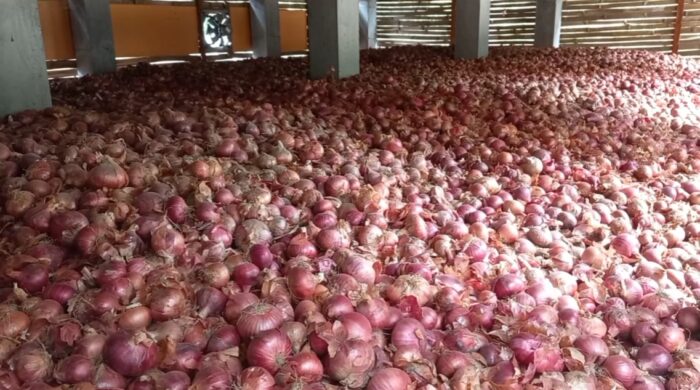


Large volumes of onions are reportedly being stored in major onion-producing regions of the country, with suspicions that certain groups directly and indirectly involved in production are hoarding supplies to capitalise on the anticipated surge in demand before Ramadan and Eid.
Allegation is that although supply at the wholesale level remains relatively stable, but retail supply is being deliberately curtailed.
According to the Department of Agricultural Marketing (DAM) and local onion farmers, more than 8,000 tonnes of onions are currently stored in 285 model storage facilities across seven districts in the southern, western and northern regions.
Sources indicate that, in addition, other individuals have reportedly stockpiled nearly 4,000 tonnes of onions.
These districts include Kushtia, Jhenaidah, Magura, Faridpur and Rajbari in the southwest and Rajshahi and Pabna in the north.
Each model storage house has a capacity of 250 to 300 maunds (approximately 10–12 tonnes). In practice, however, farmers have stored two to three times the designated capacity in many cases.
Officials from DAM and the Department of Agricultural Extension (DAE) note that these seven districts together account for around 50% of the country’s total onion production.
During the current season, onions were cultivated on approximately 188,000 hectares in these seven districts, yielding about 19 lakh tonnes. National annual demand stands at 35–36 lakh tonnes, while total domestic production is approximately 32 lakh tonnes.
Pabna leads production, with around 650,000 tonnes harvested from 44,665 hectares, followed by Faridpur, where onions were cultivated on 40,000 hectares.
In Rajbari, at least 400,000 tonnes were produced from 35,000 hectares, supported by 50 model storage houses across two upazilas. Meanwhile, Faridpur recorded production of 552,736 tonnes from 40,433 hectares, with 65 model storage houses in two upazilas.
No Structural Shortage, Yet Prices Rise
According to DAM estimates, annual onion demand ranges between 30 and 32 lakh tonnes, while domestic output this season reached 27–28 lakh tonnes. The shortfall is being met through regular imports from India and other countries, indicating no fundamental supply shortage in the market.
Nevertheless, traders and consumers allege that large wholesalers and hoarders are warehousing substantial volumes ahead of Ramadan and Eid under the pretext of rising demand. This has reduced retail availability and created scope for price escalation.
Market analysts note that onion consumption typically increases by 25–30% during Ramadan, driven by higher usage in iftar and daily meals. Hoarders are capitalising on this predictable seasonal demand to exert control over prices.
The Department of Agriculture reports that new onion planting is underway, with fresh supplies expected to enter the market in the first week of March. Ramadan, however, is set to begin in mid-February, creating a short window that hoarders are exploiting.
A stockist, speaking on condition of anonymity, said, those 20 days are more than enough for business. Even when new onions arrive, demand for old domestic onions remains distinct.
Mounting Pressure on Consumers
Consumers report that rising onion prices—alongside higher costs of rice, lentils, cooking oil, and vegetables—are sharply increasing household expenses. Low- and middle-income families in the district towns are bearing the brunt.
Sohrab Uddin, a rickshaw puller said that every Ramadan, prices go up. Cooking without onions is impossible. If prices keep rising like this, it will be very hard for ordinary people to manage household budgets.
Under the Consumer Rights Protection Act, creating artificial shortages through hoarding is a punishable offence. However, weak market monitoring is allowing hoarders to evade accountability, according to critics.
Dr. Md. Sahidul Islam, Deputy Director of DAE in Rajbari told The Daily Sun that the government itself has built the storage house for the farmers where they are supposed to store the onions produced there.
“But in few cases, it may be necessary to examine whether other parties have stored onions in these facilities,” he asserted.
Market analysts warn that without regular warehouse inspections, verification of stock levels at wholesale markets, and swift penalties, onion prices could rise further throughout the Ramadan and Eid season.
Professor Dr Mahbubul Arefin of the Department of Management at Islamic University, Kushtia, suggested several immediate measures: intensifying anti-hoarding drives, publishing daily supply data for wholesale and retail markets, simplifying import procedures, and selling onions through government-run open market sales (OMS).
He cautioned that “Unless these steps are taken promptly, onion prices may remain beyond the reach of ordinary consumers throughout the entire Ramadan and Eid period.”
Aman/