



Final Feasibility Study Near Completion, Promising Faster Trade and Stronger Bangladesh–India Rail Connectivity
The long-awaited Jashore–Benapole double-track railway project, aimed at improving connectivity with Bangladesh’s largest land port, has reached a significant milestone as its feasibility study enters the final stage. Initiated in 2024 under the Connectivity Improvement Preparatory Facility (CIPF), the project is expected to enhance passenger services, facilitate cross-border trade, and strengthen rail connectivity between Bangladesh and India.
According to Bangladesh Railway officials, the approximately 38-kilometre Jessore–Benapole route currently operates on a single track, forcing passenger and freight trains to wait for crossings and causing frequent delays. The existing line has reached its operational capacity, limiting the introduction of additional train services despite growing demand.
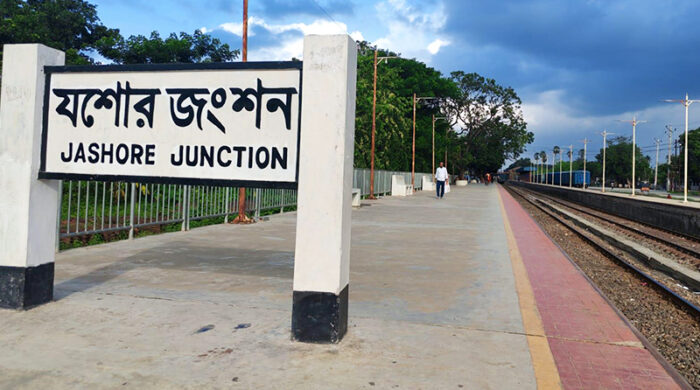
As part of the feasibility assessment, a high-level Bangladesh Railway team recently inspected Jessore Railway Junction, Benapole Railway Station, existing tracks, bridges, and other key infrastructure. Technical, economic, and environmental evaluations are now nearing completion, after which the final report will be submitted to the government for approval.
Officials believe that once the double-track line is completed, travel time between Dhaka and Benapole via Jessore could be reduced by 30 to 45 minutes. The project is also expected to improve schedule reliability and create opportunities for additional passenger and freight trains from Dhaka, Khulna, Chattogram, and northern Bangladesh.
The project is particularly important for Benapole Land Port, the country’s busiest land port, where large volumes of import and export goods are transported by rail every day. Increased rail capacity would enable freight trains to enter and leave the port more efficiently, reducing transport costs, delays, and congestion.
Officials also note that the Jessore–Benapole corridor forms part of the Trans-Asian Railway Network. Once completed, the double-track line is expected to strengthen regional rail connectivity and support subregional trade involving Bangladesh, India, Nepal, and Bhutan.
However, the project still faces engineering and land acquisition challenges, including the planned construction of a new broad-gauge railway bridge alongside the existing bridge over the Kapotaksha River in Jhikargacha. Following completion of the feasibility study, the government will decide on project financing and implementation.